
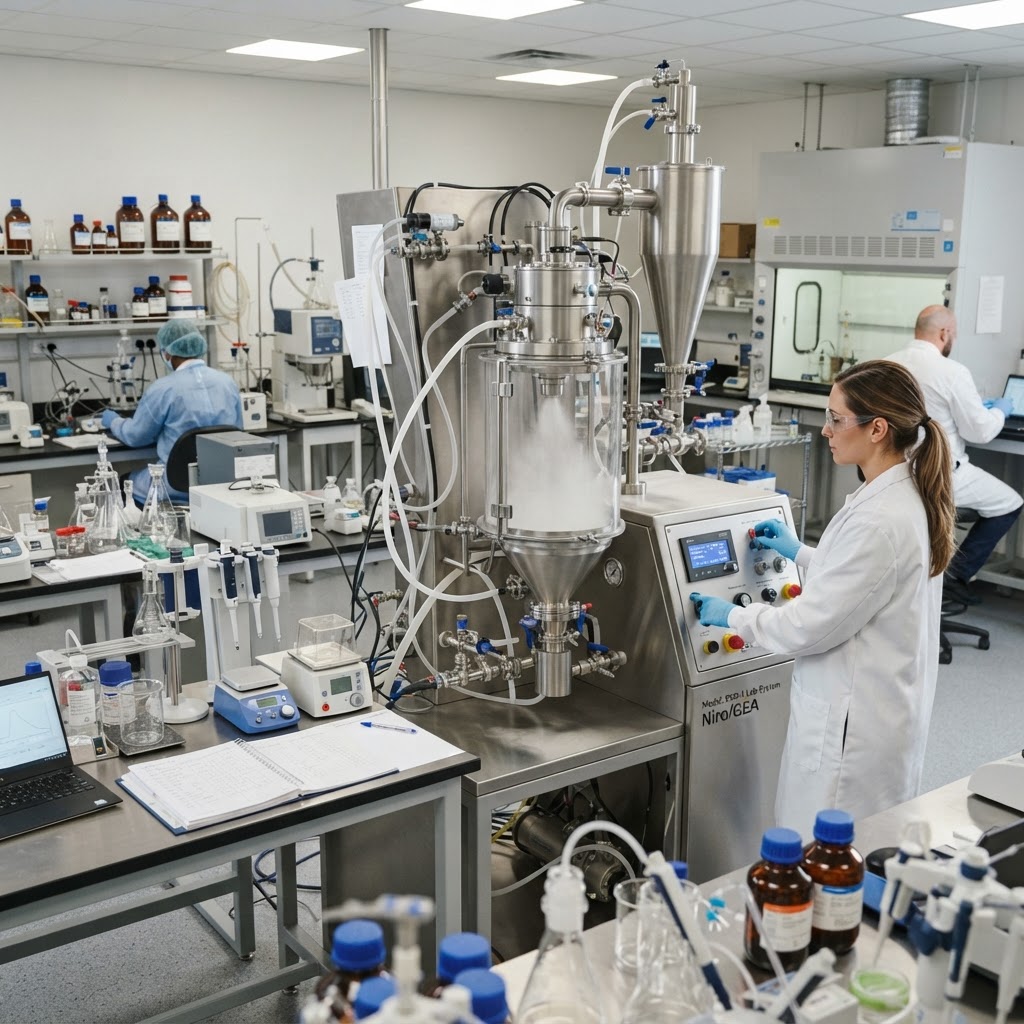
Inhaled drug delivery offers direct access to the lungs for local treatment of conditions such as asthma and chronic obstructive pulmonary disease, and increasingly for systemic delivery. Dry powder inhalers (DPIs) are widely used because they are propellant-free, portable and breath-actuated. Developing a DPI product, however, is demanding: the formulation, the device and the patient's inspiratory effort all determine whether the drug reaches the target in the lungs. This paper covers particle engineering, device selection, aerodynamic performance testing and bioequivalence approaches for DPI products.
How Dry Powder Inhalers Work
DPIs deliver drug as a powder that the patient inhales through the device. Energy from the patient's inspiratory flow disperses the powder into particles that must be small enough to reach the lung. The aerodynamic diameter, which depends on size, density and shape, determines where particles deposit: particles roughly 1 to 5 micrometers reach the lower airways, while larger particles impact in the mouth and throat. Because DPIs rely on patient effort, performance can vary across populations such as children, the elderly and those with severe disease.
Device Types
- •Capsule-based devices, where a capsule is pierced and inhaled
- •Blister-based devices with pre-metered doses
- •Reservoir devices that meter doses from a bulk powder store
Particle Engineering and Formulation
Micronization and Alternative Methods
Jet milling produces micronized drug particles in the respirable range, but can generate amorphous regions and static charge. Spray drying, spray freeze drying, supercritical fluid methods and crystallization techniques yield engineered particles with controlled size, density and surface properties. Porous or low-density particles can disperse efficiently and carry higher doses.
Carrier-Based Blends
Many DPIs blend micronized drug with larger carrier particles, usually lactose, which improve flow and dosing accuracy. Drug must adhere sufficiently to the carrier for blend uniformity yet detach during inhalation. Carrier size, surface roughness and fines content influence performance. Ternary components such as magnesium stearate or lactose fines can modulate adhesion.
Carrier-Free and Engineered Formulations
Engineered particles with surface modifiers can be formulated without carriers, enabling high drug loading, as for some biologics and antibiotics. Stability against moisture and physical changes is critical, since humidity can affect aerosol performance.
- •Control particle size distribution and crystallinity
- •Manage electrostatics and cohesion
- •Evaluate moisture sorption and physical stability
Device Interaction and Resistance
Matching Formulation and Device
The device and formulation function as a system. Device resistance influences the inspiratory flow rate a patient can achieve; high-resistance devices yield lower flow rates but may enhance dispersion efficiency. Deagglomeration mechanisms, such as cyclones, grids or capsule vibration, determine how effectively the powder is dispersed at available flow rates.
Patient Considerations
Performance should be acceptable across the range of inspiratory flows patients can achieve, including those with compromised lung function. Human factors engineering ensures that patients can load, prime and use devices correctly, a major determinant of real-world effectiveness. Dose counters and feedback features support adherence.
Aerodynamic Performance Testing
Cascade Impaction
Cascade impactors such as the Next Generation Impactor separate emitted dose by aerodynamic size, producing the aerodynamic particle size distribution. Metrics include fine particle dose and fraction, mass median aerodynamic diameter and geometric standard deviation. Testing is performed at flow rates representing patient use and across the device's range.
Delivered Dose Uniformity
Delivered dose uniformity measures the amount of drug emitted per actuation across beginning, middle and end of device life and between devices. Consistent delivered dose is a key quality attribute.
Method Development
Test methods must be robust and discriminating, with controlled environmental conditions, sample preparation and analytical quantification. Methods are validated, and in vitro in vivo correlations are explored where possible.
Bioequivalence for Generic DPIs
Weight-of-Evidence Approach
Because systemic exposure does not always reflect lung deposition, regulators use a weight-of-evidence approach for locally acting orally inhaled products. This typically includes formulation and device comparisons (Q1/Q2 sameness and device similarity), in vitro studies such as aerodynamic particle size distribution and delivered dose, pharmacokinetic studies and, where required, pharmacodynamic or clinical endpoint studies. Population bioequivalence statistics assess in vitro equivalence.
Device Substitution
Differences in device design can affect patient handling and performance. Comparative use studies and human factors data help establish acceptable substitution.
Manufacturing and Quality Control
Powder handling requires humidity-controlled environments, and micronization or spray drying demands process control. Blending uniformity, filling accuracy for capsules or blisters and device assembly are validated. In-process controls and release testing include assay, content uniformity, delivered dose and aerodynamic particle size distribution. Container closure and device components must be compatible with the formulation.
Regulatory Pathway
DPIs are combination products regulated for both drug and device aspects. Guidance documents address chemistry, manufacturing and controls, in vitro testing and clinical studies. Early scientific advice helps clarify expectations, especially for generic and novel formulations.
Emerging Trends
Inhaled biologics, vaccines and gene therapies, smart inhalers with connected sensors and low-carbon propellant alternatives for related products are shaping the field. Computational modeling of lung deposition supports design.
Conclusion
Effective DPI development depends on integrating particle engineering, device design and performance testing with a clear understanding of patient use. By addressing these elements together, developers can deliver reliable and effective inhalation therapies.
About This White Paper
This white paper is published by Biotechnology Media Insights Editorial and curated by Biotechnology Media Insights, a trusted source for pharmaceutical and biotechnology research, technical guides and industry analysis.