
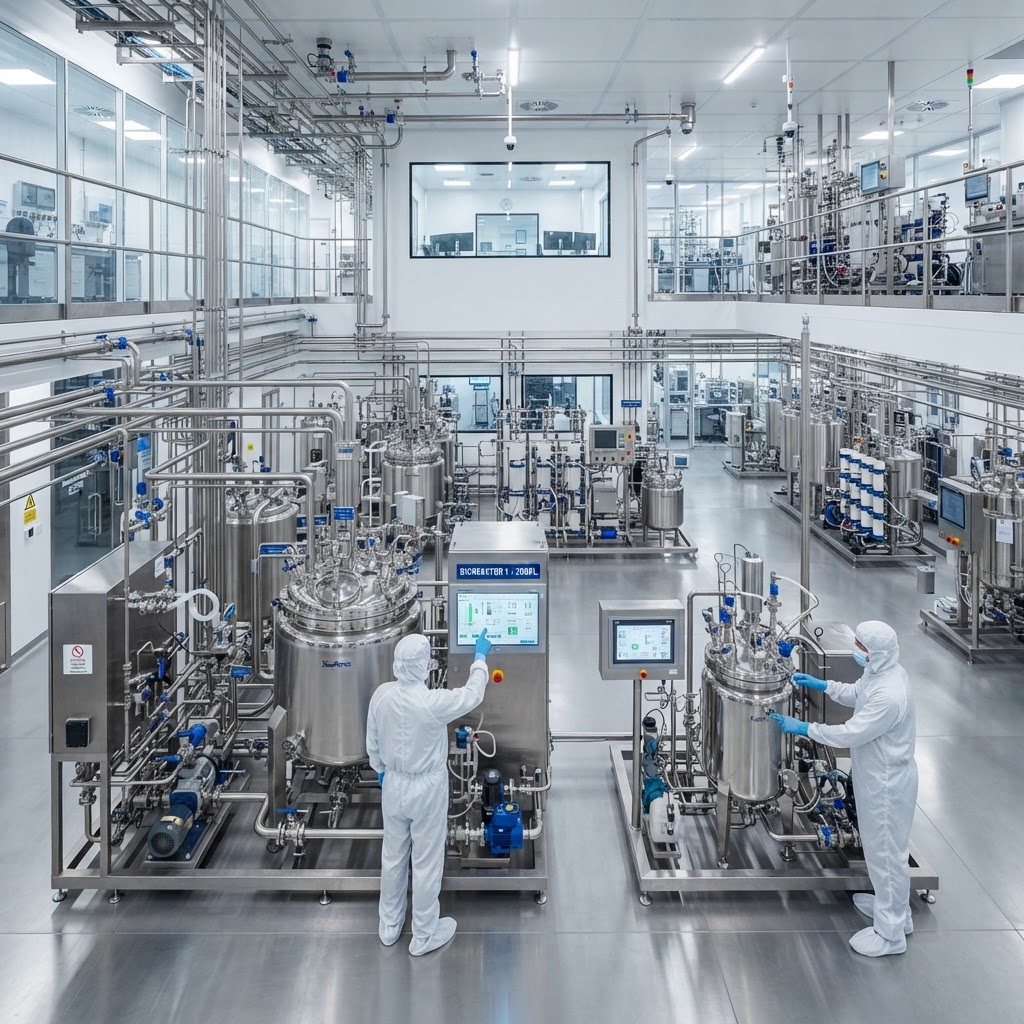
Antibody-Drug Conjugates: Manufacturing Considerations for High-Potency Payloads
Safe, compliant and scalable conjugation for next-generation targeted oncology therapies.
This white paper addresses the containment, process and analytical requirements for ADC manufacturing, including conjugation chemistry, purification and release testing.
Antibody-drug conjugates (ADCs) combine the targeting precision of monoclonal antibodies with the cell-killing power of potent cytotoxic payloads. This design allows delivery of toxins directly to tumor cells while sparing healthy tissue, and a growing number of ADCs have been approved for hematologic and solid tumors. Manufacturing ADCs, however, is demanding. It involves three components, an antibody, a linker and a highly potent payload, along with conjugation chemistry, containment and sophisticated analytics. This white paper addresses the key manufacturing considerations for ADC programs.
ADC Architecture and Manufacturing Overview
An ADC is assembled from a monoclonal antibody manufactured in mammalian cells, a synthetic linker-payload produced by organic chemistry, and a conjugation step that joins them. The result is a heterogeneous molecule whose properties depend on the number and location of attached payloads, summarized by the drug-to-antibody ratio (DAR). Each component has its own supply chain and quality requirements, and these streams converge at conjugation before purification and fill-finish.
Three Parallel Workstreams
- •Antibody production, including cell culture and purification
- •Linker-payload synthesis under high-potency containment
- •Conjugation, purification, formulation and fill-finish
Coordinating timelines across these streams is a significant project management challenge, especially when different sites or partners are involved.
Containment Strategy for High-Potency Payloads
Occupational Safety
Payloads such as auristatins, maytansinoids, calicheamicins and pyrrolobenzodiazepines are highly cytotoxic, with occupational exposure limits in the nanogram per cubic meter range. Facilities need engineering controls that protect operators and the environment.
Containment Technologies
Isolators, closed transfer systems, split butterfly valves and negative-pressure suites limit exposure. Single-use systems reduce cleaning needs, though waste handling must be controlled. Air handling, effluent treatment and decontamination procedures are designed through a risk assessment, with exposure banding guiding controls.
Cross-Contamination Prevention
Dedicated equipment or validated cleaning prevents carryover between products. Cleaning validation uses health-based limits, and sensitive analytical methods verify residue removal.
- •Perform industrial hygiene monitoring to verify containment
- •Train personnel in potent compound handling and emergency response
- •Maintain medical surveillance programs where appropriate
Conjugation and Purification
Conjugation Chemistry
Common approaches include lysine conjugation, cysteine conjugation after partial reduction, and site-specific methods using engineered cysteines, non-natural amino acids or enzymatic approaches. Site-specific conjugation produces more homogeneous products with predictable DAR, potentially improving therapeutic index. Reaction parameters such as pH, temperature, reagent stoichiometry and time must be tightly controlled.
Removing Impurities
After conjugation, free payload, unreacted linker, organic co-solvents and aggregates must be removed. Tangential flow filtration, hydrophobic interaction chromatography and other chromatography steps are used. Aggregation is a particular risk because hydrophobic payloads can destabilize the antibody. Process conditions and formulation are optimized to minimize it.
Formulation and Stability
ADCs are often lyophilized to enhance stability. Excipients and pH are selected to limit aggregation, payload release and linker hydrolysis. Stability studies track DAR, free drug and aggregate levels over time.
Analytical Control Strategy
Key Quality Attributes
Critical quality attributes include DAR and its distribution, free payload, aggregates, charge variants, potency, binding and residual solvents. Orthogonal techniques such as hydrophobic interaction chromatography, reversed-phase LC, size-exclusion chromatography, capillary electrophoresis and mass spectrometry characterize the molecule.
Potency and Safety Assays
Cell-based cytotoxicity assays demonstrate payload activity, while binding assays confirm target recognition. Because of the high potency, analytical laboratories also require containment and safe handling procedures.
Comparability and Method Lifecycle
Process changes require comparability assessments supported by sensitive methods. Establishing robust, validated analytical procedures early supports smooth technology transfers.
Regulatory Considerations
ADCs are regulated as biologics, but regulators expect thorough characterization of the antibody, linker-payload and conjugate. Control of the linker-payload as a starting material or drug substance intermediate requires well-defined specifications. Nonclinical safety packages address payload-related toxicity.
Partner Selection and Supply Chain
Few organizations offer integrated antibody, linker-payload and conjugation capability under one roof. Integrated providers reduce handoffs, shorten timelines and simplify tech transfer. When using multiple partners, clear quality agreements and communication plans are essential. Supply security of payload starting materials is also important.
Scaling Up
As clinical demand grows, scaling conjugation reactions requires attention to mixing, mass transfer and heat control. Containment must scale as well, and capacity planning should anticipate commercial volumes, since ADCs are often dosed on a per-weight basis in repeated cycles.
Conclusion
Antibody-drug conjugate manufacturing blends biologics and highly potent small molecule expertise. Robust containment, controlled conjugation, careful purification and rigorous analytics together deliver safe, consistent products. Sponsors who plan these elements early and choose capable partners can bring these powerful targeted therapies to patients efficiently.
Download This White Paper
Biotechnology Media Insights
Continue to Biotechnology Media Insights to access this white paper.